Skip to content
Preview site · Under construction

UX leadership · AI and data solution delivery

UX leadership.
AI and data delivery.

My foundation is UX leadership across complex products and services. I’m expanding into AI and data solution delivery through implemented learning prototypes and ongoing Databricks work. The ten AI experiments below document methods and prototype results, with human accountability retained.

Expanding the practice

From UX leadership into AI and data solution delivery.

Hands-on work with explicit evidence limits. These projects show a developing delivery practice; production readiness and impact remain to be verified.

Implemented learning prototype

Olist support workflow

An AI-assisted support prototype with APIs, Postgres, agents and approval flows. My work includes problem definition, review, SQL checking and debugging.

Evidence limit: Deployment is unverified. No production outcomes are claimed.

Source prototype

BI pipeline and dashboard

A source prototype covering Python ingestion, SQL transformations, Parquet outputs and a Streamlit dashboard. The next step is to reproduce and check its results.

Evidence limit: Runtime is unverified. No operational performance or business impact is claimed.

In progress

Databricks

Structured study and sample-data exercises are building the foundation for a Databricks pipeline. A completed pipeline or certification is not claimed.

Evidence limit: Work is in progress. No completed deployment or measured outcome is claimed.

Flagship workflow

Evidence → system → prototype → private critique

Code to canvas design-system workflow
Episode 6 · Prototype evidence

Code-to-canvas design systems

A reconciliation loop connects coded components, tokens and Figma assets.

Code ↔ canvas
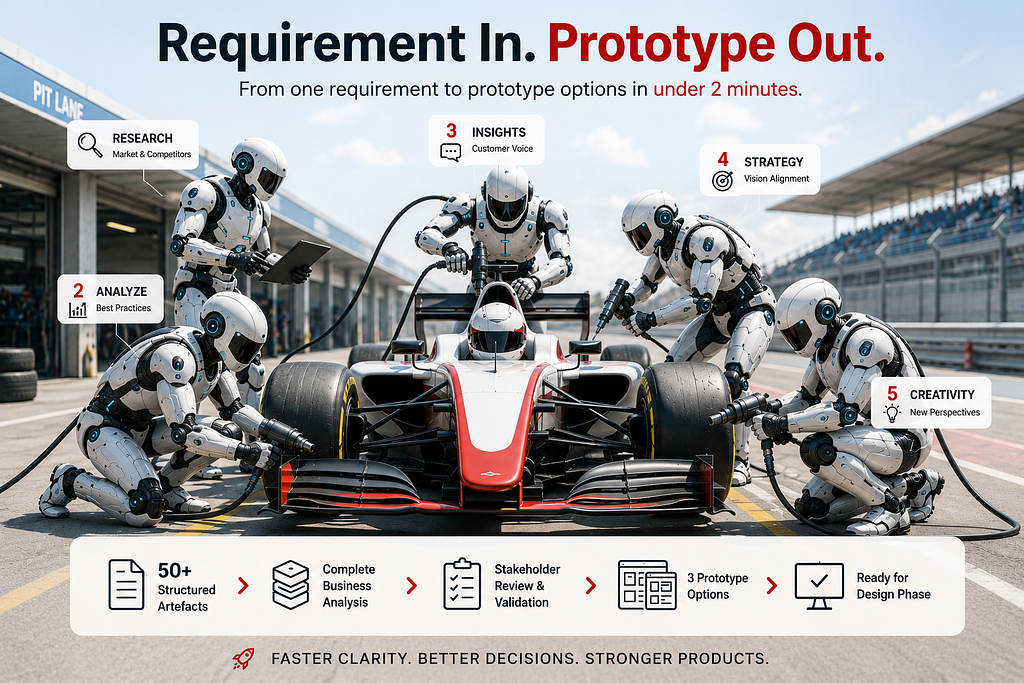
Requirement-to-prototype AI workflow
Episode 9 · Prototype benchmark

Requirement-to-prototype

Specialised agents and critics turn structured requirements into a discussion-ready prototype.

Under 2 min
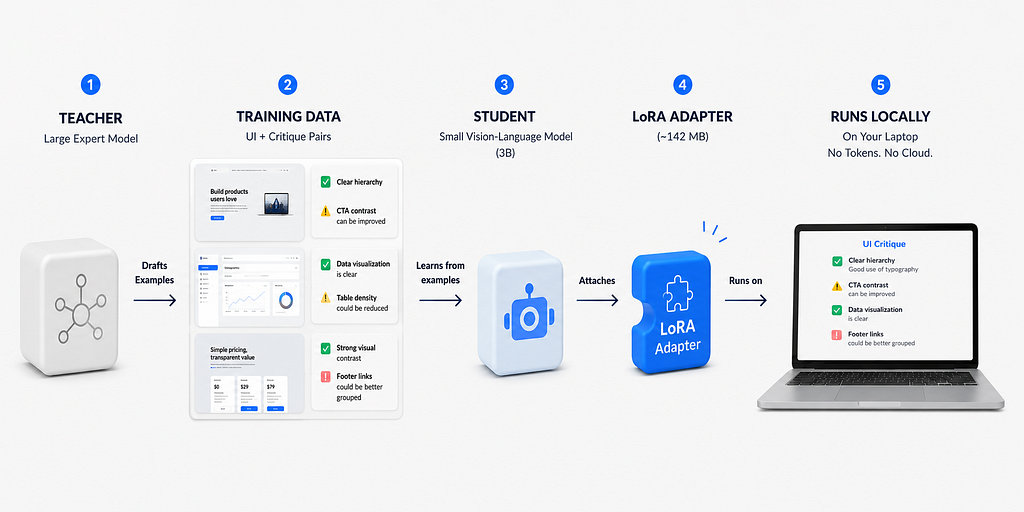
On-device vision-language model evaluating a user interface
Episode 10 · Prototype evidence

Local UI critic

A fine-tuned 3B vision-language model performs repeatable first-pass interface critique locally.

Local 3B model

From evidence to evaluated experience

Ten implementations across one operating model.

  1. 01

    Research

    Evidence and priorities

    Human approval gate

  2. 02

    Define

    Requirements and options

    Human approval gate

  3. 03

    Create

    Prototype and system assets

    Human approval gate

  4. 04

    Assure

    Evaluation and quality evidence

    Human approval gate

Capacity layer · Episodes 1 + 7

Automate repetitive production and coordination so senior talent can spend more time on decisions.

See reported example ↓

Evidence maturity

Clear about evidence and limits.

Most systems are working prototypes. Episode 09 has a prototype benchmark. Episode 01 has a reported task comparison (validation pending), not a verified result.

  1. 1Idea—
  2. 2Prototype01–08 · 10
  3. 3Benchmark09
  4. 4PilotNext
  5. 5Verified—

Complete evidence library

Scan the value. Open the implementation.

01

Operational efficiency

Repetitive production and coordination work consumes senior design capacity.

Return specialist time to decisions.

Reduce low-value effort and create more capacity for judgement, collaboration and quality.

Human control: Start with high-volume, low-risk tasks. Require approval before actions or outputs move forward.
EP 01Repetitive work automationRepetitive work automation

An agent prepares a structured production output for human review.

Value: Reported task comparison: five days to thirty minutes for the defined task; validation pending.

Human: Human reviews the prepared output before use.

5 days → 30 minReported task comparison (validation pending)
Read complete article on Medium ↗
EP 07Workday command centrePersonal AI command center dashboard

A personal control layer coordinates briefings, tasks and routine actions.

Value: Potential to reduce coordination overhead; team adoption requires access controls.

Human: User approves actions; organisational use needs access controls.

One control layerPrototype evidence
Read complete article on Medium ↗
02

Research intelligence

Research, customer reviews and behavioural data are slow to combine and interpret consistently.

Turn fragmented evidence into priorities.

Potentially compress evidence gathering, increase coverage and focus teams on journeys worth investigating.

Human control: Keep source links, privacy boundaries and researcher validation visible throughout the workflow.
EP 02Secondary research agentsSecondary research agents

Parallel agents discover, compare and organise sources for researcher validation.

Value: Potential to reduce evidence-gathering effort and broaden source coverage.

Human: Researcher validates sources, relevance and synthesis.

Broader coveragePrototype evidence
Read complete article on Medium ↗
EP 03Review intelligenceReview intelligence

A LangGraph workflow structures customer reviews into themes and priorities.

Value: Potential to accelerate voice-of-customer analysis and issue detection.

Human: Researcher reviews themes against the source comments.

Faster synthesisPrototype evidence
Read complete article on Medium ↗
EP 05Behavioural friction analysisBehavioural friction analysis

Seven agents connect GA4 and Microsoft Clarity signals to testable UX hypotheses.

Value: Potential to reduce analysis effort and focus investigation on priority journeys.

Human: Analyst validates hypotheses against journeys and context.

7 agentsPrototype evidence
Read complete article on Medium ↗
03

Delivery acceleration

Ideas, requirements, design systems and prototypes lose time and meaning across handoffs.

Move from evidence to something testable.

Potentially shorten alignment cycles and reduce rework before formal design and engineering delivery.

Human control: Treat generated requirements and prototypes as drafts until product, design and engineering approval.
EP 06Code-to-canvas design systemsCode to canvas design-system workflow

A reconciliation loop connects coded components, tokens and Figma assets.

Value: Potential to reduce design-development drift and repetitive documentation.

Human: Design and engineering approve reconciled changes.

Code ↔ canvasPrototype evidence
Read complete article on Medium ↗
EP 08Idea and requirement agentsAgent-driven innovation and requirements workflow

Agents challenge opportunities, surface assumptions and structure draft requirements.

Value: Potential to expose gaps earlier and improve discovery throughput.

Human: Product and design owners accept, reject or revise drafts.

Earlier challengePrototype evidence
Read complete article on Medium ↗
EP 09Requirement-to-prototypeRequirement-to-prototype AI workflow

Specialised agents and critics turn structured requirements into a discussion-ready prototype.

Value: A prototype was generated in under two minutes; design and engineering review remains mandatory.

Human: Design and engineering review every generated prototype.

Under 2 minPrototype benchmark
Read complete article on Medium ↗
04

Quality, privacy & risk

Manual interface review is repetitive, specialist capacity is limited and some material is sensitive.

Evaluate earlier, locally and repeatedly.

Potentially increase review coverage, surface drift earlier and protect sensitive interface material.

Human control: Use shadow mode, golden datasets, false-positive tracking and explicit human override.
EP 04UI regression checksUI regression checks

Automated comparison flags likely interface changes for specialist review.

Value: Potential to detect defects and design-system drift earlier.

Human: Specialist confirms defects and release decisions.

Earlier detectionPrototype evidence
Read complete article on Medium ↗
EP 10Local UI criticOn-device vision-language model evaluating a user interface

A fine-tuned 3B vision-language model performs repeatable first-pass interface critique locally.

Value: Potential to reduce specialist pre-review effort while protecting sensitive material.

Human: Specialist owns the final critique and prioritisation.

Local 3B modelPrototype evidence
Read complete article on Medium ↗

Consulting adoption path

From useful prototype to responsible practice.

  1. 01DiagnoseFind costly friction
  2. 02PilotTest in shadow mode
  3. 03MeasureCompare the baseline
  4. 04GovernSet controls and ownership
  5. 05ScaleExpand after evidence